NeurIPS 2026 submission
Parason
Revealing subtask and trial parallelism in LLM reasoning.
Turn long sequential traces into executable parallel programs, then train the model to balance correctness, search, and wall-clock latency.
The missing taxonomy
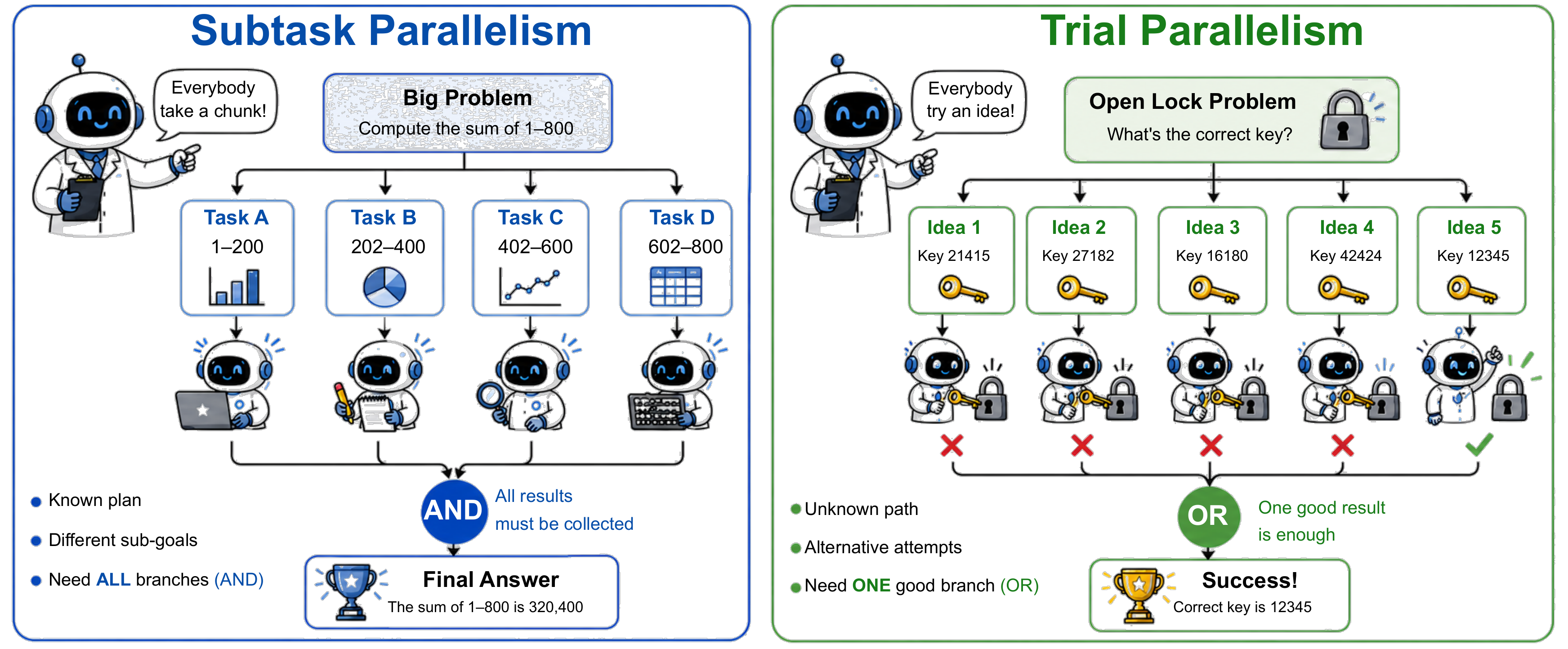
Not every parallel branch means the same thing.
Parason separates reasoning that divides known work from reasoning that explores uncertainty. The distinction changes how branches are trained, executed, and merged.
OR branches
Trial parallelism
Launch competing attempts when the right route is unknown. One useful path can unlock the answer, while failed attempts still inform the final synthesis.
- Unknown solution path
- Alternative hypotheses
- Exploration is merged into context
What the traces reveal
Trial parallelism grows with difficulty.
Across every model studied on Humanity's Last Exam, more than half of the parallelizable steps are speculative trials. Hard reasoning is not only about decomposition. It is also about trying, rejecting, and refining uncertain paths.
Training and systems co-design
From a sequential trace to an executable parallel program.
The same structured contract connects data curation, reinforcement learning, and inference-time dispatch.
-
01
Reveal
Label existing reasoning stages as required subtasks or speculative trials.
-
02
Structure
Encode branches with a context-free grammar that stays valid and engine-parseable.
-
03
Optimize
Use PA-GRPO to reward correctness, shorter critical paths, and useful branch types.
-
04
Execute
Dispatch each branch as a tool call, run workers concurrently, and merge their outputs.
<Parallel>
  <Outlines>
    <Trial>factorization</Trial>
    <Trial>modular arithmetic</Trial>
    <Trial>constructive search</Trial>
  </Outlines>
  <Thread>Try factorization.</Thread>
  <Thread>Test modular arithmetic.</Thread>
  <Thread>Run constructive search.</Thread>
</Parallel>
Runtime contract
Minimal engine changes.
XGrammar enforces valid tags. SGLang decodes normally until a parallel region appears, dispatches independent workers, then returns each thread to the main trajectory.
Live run
Same token rate, half the wall clock.
A single AIME24 problem decoded twice at an identical 749.6 tok/s. The sequential trace spends every token on one critical path; Parason spawns its threads at </Outlines> and only pays for the longest one.
Results
More accuracy when latency is tight.
Parason moves useful work into parallel branches, so the longest generation path grows more slowly than the total reasoning trace.
| Model | AIME24 Accuracy (%) | |||
|---|---|---|---|---|
| B=2,048 | B=8,192 | B=16,384 | B=24,576 | |
| SFT only | 16.8 | 41.8 | 66.8 | 70.2 |
| PA-GRPO (βsubtask = 0.025) | 16.7−0.10 | 45.2+3.40 | 68.0+1.20 | 73.2+3.00 |
| PA-GRPO (βsubtask = 0.050) | 26.8+10.00 | 60.0+18.20 | 72.2+5.40 | 74.8+4.60 |
| PA-GRPO (βsubtask = 0.100) | 34.7+17.90 | 60.3+18.50 | 74.4+7.60 | 75.7+5.50 |
Critical-path savings
Harder problems expose more parallel work.
Acceleration stays stable as problems get harder, while the absolute number of tokens moved off the critical path increases. Measured wall-clock speedups are 1.62x on easy, 1.38x on medium, and 1.47x on hard problems.
Benchmark coverage
Competitive accuracy with an 8B model.
Best reported PA-GRPO results across the evaluated settings.
Read the full paper